Birds of Prey

Wedge-Tailed Eagle

Birds of prey hold a special fascination for us humans, and Australia’s birds of prey are no exception.  We gaze in wonder at them as they soar high above the earth, effortlessly riding the wind thermals, searching the ground far below for food using their exceptional vision. 

In many cultures they symbolize spiritual attainment; their high soaring habit representing a capacity to rise above earthly concerns and to view issues from a dispassionate position, a place of wisdom.  We use the expression ‘eagle-eyed’ for people of keen vision and insight.

(more…)

Australia’s Endangered Wildlife

The endangered Western Quoll, Alice Springs Desert Park.

INTRODUCTION

Where do you start on a topic like this?  When Nirbeeja suggested this as a good theme for a new post, I must admit to feeling completely overwhelmed.   “Endangered wildlife” isn’t the theme for a post, it’s a lifetime’s work.  I soon realised that my initial reaction symbolised how we all feel about this issue – basically that it’s too big to deal with.  As a result we pretend it isn’t there and move on to something easier, or go see a movie, or eat some chocolate….or do whatever it is that we do to avoid reality.

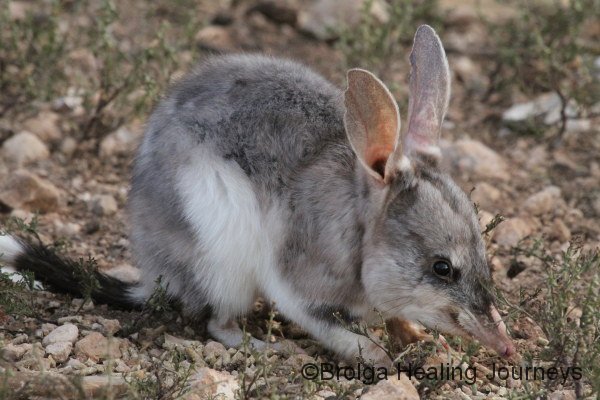
Of course, if we all did that, many Australian species of marsupial, bird, reptile and amphibian, not to mention plants, would disappear in the blink of an eye.  In fact many already have, never to be seen again.  The delicate Lesser Bilby, once seen in the central desert regions, is gone.  Wiped out.  Extinct.  Call it what you like, it is now but a memory.  When you see a real, live Greater Bilby, its bigger and more robust cousin, although it too is a delicate, fragile creature under threat of extinction, you realise that the Lesser Bilby stood no chance at all against efficient feral predators and environmental degradation.  Unfortunately the Lesser Bilby isn’t alone.  As I wrote in the introduction to the earlier marsupials post on this site, Australia holds the unfortunate record for mammal extinctions in the modern world.  Let’s not add to that record if we can help it!

(more…)

Aboriginal Rock Art of the Burrup Peninsula


j8dampier-burrup-peninsula-233

The Burrup Peninsula, about two thirds of the way up the enormous Western Australian coastline, is home to the world’s most extensive concentration of rock art, yet is relatively unknown.  Although there has never been a full inventory of the petroglyphs in the region, bodies such as the National Trust of Australia (WA) suggest that there could be up to 1 million individual works.  I am astounded that a place of such cultural significance is not World Heritage listed.  But read on, and you will learn why.

(more…)

Partial Lunar Eclipse – 26 June 2010 – Observed from Alice Springs NT, Australia

We admired the beautiful full moon in the early evening of 26 June 2010, but had no idea that there was to be a partial lunar eclipse, until we received a phone-call from my father in Canberra suggesting we have a look into the night sky.  A lunar eclipse occurs when the earth’s shadow blocks the sun’s rays from striking all or, in the case of a partial eclipse, some of the moon.  As it can only occur when the sun, earth and moon are in full alignment (or close to it), a lunar eclipse only occurs during the full moon.  Around half of the moon was to be in shadow during this eclipse. 

Unfortunately, we missed the start of the partial eclipse, and the first couple of hand-held photos are somewhat blurred.  Once the tripod was set up the photos improved.  I took the first photo at 8.06 PM Australian Central Standard Time (8.36PM Aust Eastern Standard Time) and took the final one of the series at 10.36PM ACST, by which time I was just about frozen solid.

Thanks Mum and Dad for the call!

Partial lunar eclipse seen from Alice Springs, 26 June 2010, 8.06PM Australian Central Standard Time

(more…)

Recent photos – June 2010

Butterfly on Melaleuca blossom, Stuart Hwy, Alice Springs

Here are some (mostly) recent photos.  Where appropriate I’ve added them to other galleries on the site.  Hope you enjoy them!

(more…)

Kookaburras, Kingfishers and Bee-eaters

Laughing Kookaburra, Big Brook campsite, near Pemberton WA

THE LAUGHING KOOKABURRA

Kookaburra sits in the old gum tree,
Merry, merry king of the bush is he,
Laugh, Kookaburra, laugh, Kookaburra,
Gay your life must be!

(more…)

Finke Desert Race 2010

Car no 70, going for broke close to the finish

Alice Springs comes alive during the cooler winter months, and the annual Finke Desert Race is one of its many attractions.  It is a gruelling event, stretching some 229km from Alice Springs to Apatula Community on the Sunday, then returning to Alice on the Monday of the June long weekend.  The race crosses the Finke River, believed to be the oldest river in the world.  To travel this track at a cautious pace in a 4WD is challenging enough, but to race across it at breakneck speed is mindboggling.  This year the number of motorcycle entrants was limited to 500.  This surprised me, because I thought you’d have trouble finding 100 suicidal maniacs to enter the event, let alone 500!  Seventy or so 4-wheeled entrants also entered the event.  I hesitate to call them cars, as they resembled something you’d more likely see in a Mad Max movie.

(more…)

Woodswallows

A pair of Black Faced Woodswallows - a tender moment!

The Woodswallows are not particularly well known birds, even though they are widespread across Australia.  They are skillful fliers, catching their insect prey on the wing. In the case of the Little Woodswallow, they are often seen soaring high above mountaintops or rocky outcrops to feed.  Many times during our travels they have been companions to us, of sorts, as we have taken in the view after a strenuous climb, and notice these little birds zooming around nearby.  Their clever aerobatics seem almost mocking of our clumsy, earthbound ways.

(more…)

Channel-Billed Cuckoo

The fledgling Channel-Billed Cuckoo grows excited as its Crow 'parent' flies in to feed it.

Nirbeeja grew up on a ginger and produce farm in Buderim, in south-eastern Queensland.  It was an idyllic existence, in a beautiful part of our country before the area was over-developed.  During the stormy summer months she would often hear an unusual bird call, and was informed by her father that it was made by the Storm Bird, and heralded the coming rains.  She often heard the call but doesn’t recall seeing the bird.

She was therefore very excited to hear the same call here in Alice Springs, during our stormy weather last summer.  She was even more excited to see the bird making the call. At last!  After much consulting of our bird-books, she decided that the so-called Storm Bird was none other than the Channel-Billed Cuckoo.  Interestingly, the local Aboriginal people say that when the Channel-Billed Cuckoo is seen in this area, it means big rains are coming.  And they are right, for the Todd River has flowed three times this year after consistent heavy falls.

(more…)

Australian Pigeons and Doves

Spinifex Pigeon, Mt Augustus, WA 

At first glimpse, most of our native pigeons and doves are unspectacular.  They are not especially colourful or large, nor do they entertain us with beautiful songs.  Indeed, the songs of many of the pigeons and doves border on the mournful.  There is, however, a wonderful range of native pigeons and doves spread across the country. 

(more…)